Rabat is the city of Pirates, Storks and the unfinished Tower. Plenty of Tasty Food and without the Crowds.
RABAT: Most people fly over Rabat on their way to somewhere louder. Marrakech gets the snake charmers, Fez gets the tanneries, Chefchaouen gets the blue Instagram walls. Rabat gets the ministries.
That is exactly why you should visit Rabat. The capital of Morocco, the seat of the King, and the city where the country decides how it wants to look to the world. It is also the place where nobody grabs your sleeve in the medina. The hustlers went to Marrakech, where the money is. What stayed behind is a city of civil servants, diplomats, students, fishermen and grandmothers who will tell you, without being asked, that you are holding your bread wrong.
I have been to 80 funerals around the world. In Rabat I went looking for the opposite: the ordinary Tuesday. What I found was a city running on rules that nobody writes down, because everybody already knows them. Everybody except me.
Three Dates and No Price
I walked into a small shop off Rue des Consuls to buy a scarf. Before I could ask the price, the owner pushed a stool toward me, poured a glass of mint tea and set down a saucer of dates. We talked about Spain. We talked about his cousin in Lyon. We talked about the weather in the Arctic, which he did not believe.
Forty minutes later I still did not know what the scarf cost. When I finally asked, he waved his hand: “Later. You are a guest.”
Here is the collision. In my world, a shop is a place where you exchange money for goods as efficiently as possible. Small talk is a delay. In Rabat, the tea is not a delay before the business. The tea is the business. The scarf is almost an afterthought.
And the paradox runs deeper. Rabat is the most modern, most orderly, most European-looking city in Morocco: trams, wide boulevards, a 250-metre skyscraper. Yet it is also where the old codes of hospitality, bread and family are kept most carefully. The city that looks the most Western is, underneath, the most Moroccan.
Pirates, Refugees and Kings
Rabat’s personality was shaped by four waves of history, and each one left a rule behind.
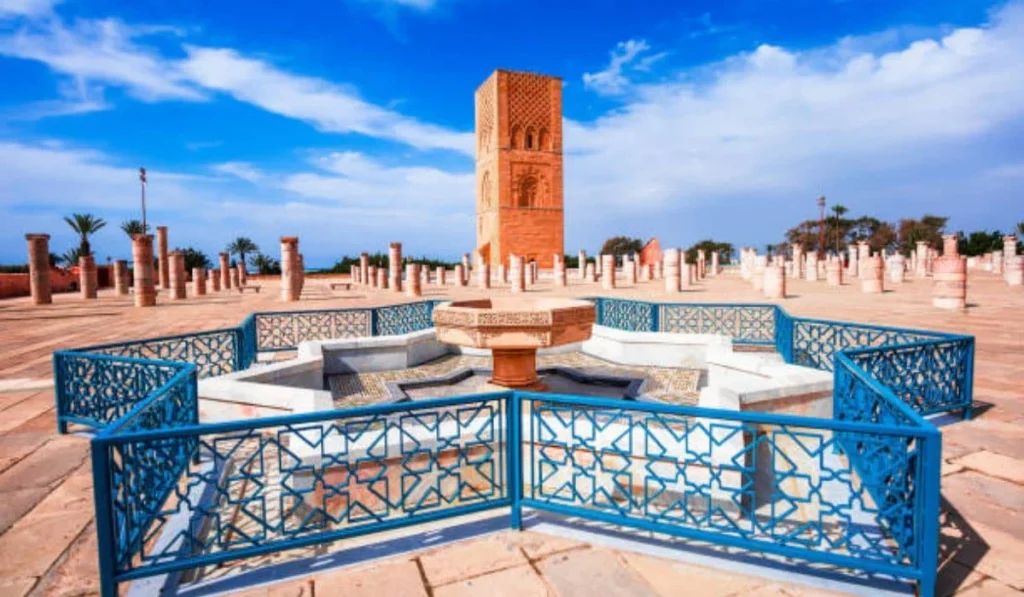
The fortress (12th century). The Almohad dynasty built a ribat, a fortified camp, at the mouth of the Bou Regreg river. That is where the name comes from. Sultan Yaqub al-Mansur planned the largest mosque in the world here. He died in 1199, the work stopped, and the Hassan Tower still stands unfinished. Rabat learned early that grand plans can wait.
The refugees (17th century). When Spain expelled the last Moriscos between 1609 and 1614, thousands of Andalusian Muslims crossed the strait and settled in Rabat and Salé. They brought Andalusian music, recipes heavy with almonds, cinnamon and orange blossom, and a family snobbery that survives today. Old Rabati families still trace their names back to Spain.
The pirates. For a few wild decades in the 1600s, the river mouth was the base of the “Salé Rovers”, men who raided ships as far away as Cornwall and Iceland, and ran a semi-independent pirate republic. Rabat and Salé are rivals to this day, separated by a river and centuries of mutual suspicion.
The protectorate (1912–1956). When France took control, Resident-General Lyautey moved the capital from Fez to Rabat. He built a new European city beside the medina, not on top of it. That decision explains the city you see now: old and new living side by side, without mixing much.
The political elite lives in Rabat. The Royal Palace, the government, parliament, the ministries and every embassy are here, and the villa districts are where power sleeps. But the money elite, the business families and bankers, mostly live in Casablanca, an hour south. Locals put it simply: Casablanca earns it, Rabat decides how to spend it.
Unwritten Rules of Rabat
A guest is greeted with dates and milk, at a wedding, at a front door, at the end of a Ramadan fast. Eat at least one. Refusing is like refusing a handshake.
Bread is sacred. Khobz is never thrown in the bin. If a piece falls on the street, someone will pick it up, kiss it or touch it to the forehead, and place it on a ledge or wall where birds can find it.
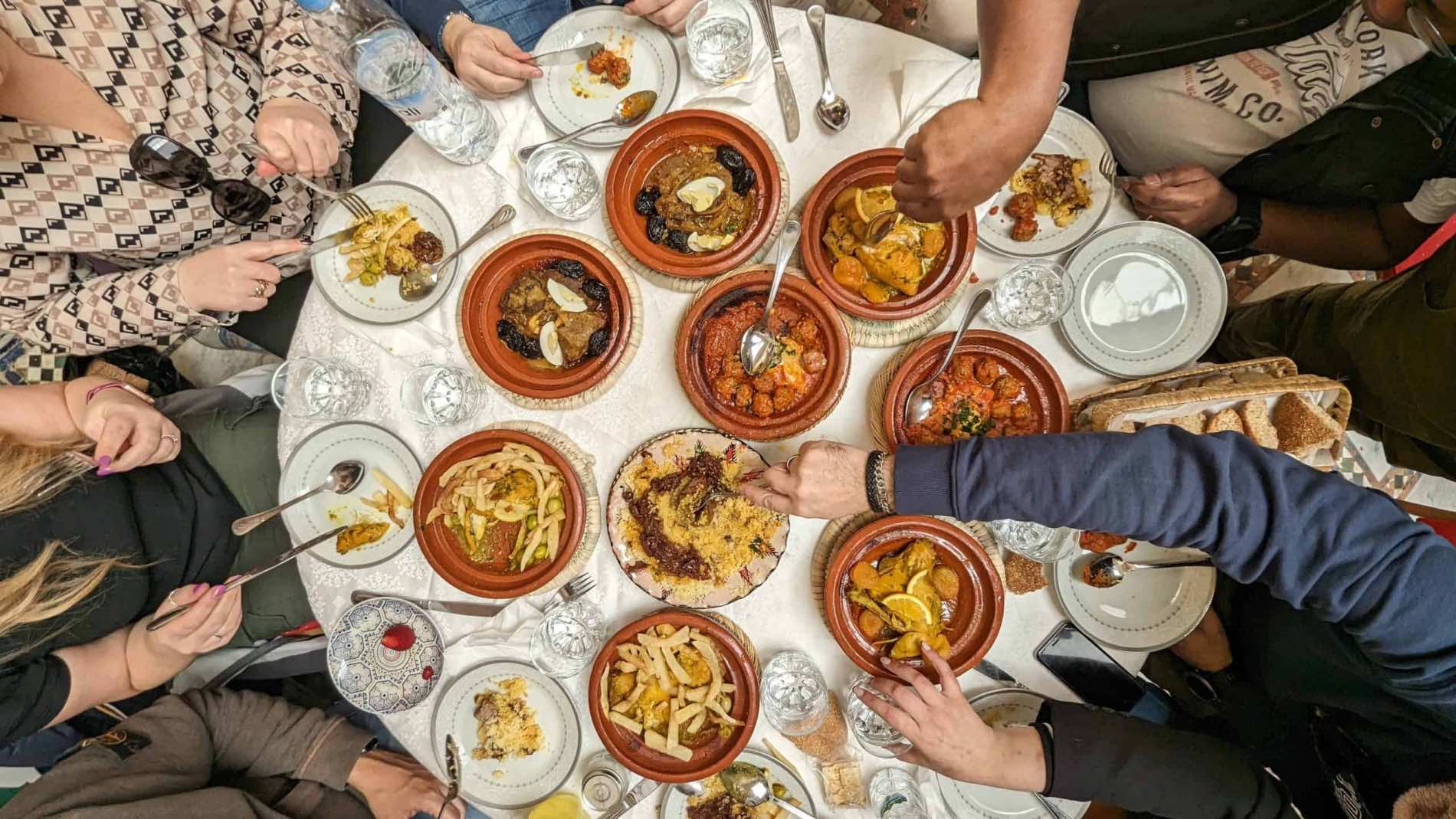
Eat with the right hand, from your own section. The tagine is shared, but it has invisible borders. You eat the triangle in front of you. The best pieces of meat in the middle are given to you by the host. Do not go hunting for them.
Mint tea is offered everywhere: shops, offices, homes. The first refusal is politeness. By the third offer, you accept.
In the souk, the first price is an opening statement, not a fact. Bargaining is a conversation, not a fight. Smile, offer less, accept tea, and walk away gently if it is too much. In Rabat the first price is usually less inflated than in Marrakech, so do not push too hard.
After the midday Friday prayer, families gather around one large plate of couscous. Restaurants that serve couscous on other days are mostly serving tourists.
“Inshallah” is a full sentence. “God willing” can mean yes, maybe, or a polite no. The tone tells you which. Learn to listen for it.
Morocco is a Muslim country, but alcohol is legal. Licensed hotels, bars and restaurants serve beer and wine, and supermarkets have a separate alcohol section.
The hammam is a weekly reset. The public bathhouse is not a spa. It is where neighbours meet, gossip, and scrub each other clean with black soap and a rough kessa glove.
Family is the operating system. Jobs, apartments, doctors and favours run through cousins and neighbours. If you make a Rabati friend, you will soon meet their mother. That is not a formality. That is the inspection.
The Jokes in Morocco
After ten rules, you might think Rabat is a city of manners and nothing else. It is not. Morocco laughs constantly, loudly and often at your expense. The trick is that the joke is almost never about the person telling it.
The Moroccan word for a joke is nokta. Moroccans tell them in Darija, the street Arabic, because the jokes do not survive translation into classical Arabic or French. Half the fun is the wordplay, and half of that is untranslatable.
Walk the Medina. Rabat’s medina is small enough to walk in an afternoon and real enough that people actually live in it. Here, the souk is not a theatre for visitors. It is where Rabatis buy their socks, their mint and their phone chargers.
Start at Bab el-Had, the old gate on the western side. Go early, around nine, when the bakers are pulling khobz from communal ovens. Families still bring their own dough on wooden boards, marked so they get the right loaves back.
First stop: a bowl of bissara. A thick soup of dried split fava beans, garlic, olive oil, cumin and a red dusting of paprika. It costs almost nothing and it is what workers eat before a long day. Dip bread in it. Add more olive oil than seems reasonable.
Near the river, grilled sardines are served stuffed with chermoula, a paste of coriander, parsley, garlic and cumin. Rabat sits on the Atlantic, and you can taste it.
Moroccans say food is a table of soul. It sounds like a slogan until you sit at one. A Moroccan table is never set for exactly the number of people expected. There is always food for one more, because someone always turns up. The meal is not fuel. It is proof that the family is still together.
Rabat’s kitchen is called Rbati cuisine, and it carries the Andalusian refugees in every dish: sweet next to savoury, cinnamon on meat, orange blossom water in everything that stands still.
Couscous is steamed semolina, rolled by hand into tiny grains and steamed two or three times over a simmering stew of meat and vegetables, traditionally seven vegetables. It is the closest thing Morocco has to a national dish. In 2020 couscous was added to list of Cultural Heritage, in a rare joint agreement with Morocco, Algeria, Tunisia and Mauritania, countries that agree on very little else. Couscous is a Friday dish, a family dish, and a dish you eat from one shared plate.
Morocco has 453 registered varieties of date palm. The most famous is the Mejhoul, the large, soft “king of dates”. People eat about three kilos of dates per person a year, and many of them are imported.
In Rabat, look for dates stuffed with almond paste, walnuts or orange-scented marzipan, served at weddings and to guests.
Tangine, slow-cooked stew in a clay pot. Pastilla, pastry pie. Harira soup. Bissara, bean soup with olive oil and cumin. Grilled sardines fresh from the Atlantic. Spiced coffee and mint tea.
Secrets. Morocco is not Arab in the way you think. A large share are of Amazigh (Berber) origin, and Tamazight became an official language beside Arabic in 2011. The everyday language, Darija, mixes Arabic, Amazigh, French and Spanish. A Moroccan can switch between four languages inside one sentence.
Nobody is ever really lost. Ask for directions and five people will give you five different answers, all with total confidence. Being helpful matters more than being right.
Hospitality has a budget, and it is yours. A family with very little will still serve you the best they have. Accept it. Refusing is the insult, not the cost.
The weekend has two calendars. Officially Saturday and Sunday, spiritually Friday. Many shops close at Friday prayer; offices slow down.
Women run the house, and increasingly the country. The family code was reformed in 2004 and is again under revision. In Rabat you will see women ministers, women judges and women running medina businesses. The street is still male; the home is not.
Secrets of Rabat. In Rabat river is the border.Rabat and Salé face each other across the Bou Regreg. They share a tram, but not a sense of humour. Ask a Rabati about Salé and watch his face.
The Kasbah of the Udayas was the headquarters of the 17th-century republic. Today it is the most photographed blue alley in the city, and few visitors know they are standing in a former pirate base.
Storks own the ruins. At the Chellah, the Roman and Merinid ruins on the edge of town, storks nest on every minaret. Locals believe they bring good luck, and that the eels in the old sacred pool grant wishes to women hoping for a child.
What to Explore. The best thing to explore in Rabat is people. Sit in the same café three mornings in a row. On the third day, the waiter will bring your order before you ask. By the end of the week, you will be invited to someone’s home for couscous on Friday. Say yes.
The Art. Visit Mohammed VI Museum of Modern and Contemporary Art. The first thing you see is a broken piano. It stands on the forecourt, smashed and reassembled in bronze by the French artist Arman, and it is called Accord final. In French that means both “final chord” and “final agreement”. For a museum in the city of diplomats, it is a very good joke.
The permanent collection belongs to Morocco. More than 200 Moroccan artists are represented, from the 1950s to today. The opening show had around 500 works and the title 1914–2014: A Hundred Years of Creation.
Open 10:00 to 18:00, closed on Tuesdays. Weekday mornings are quiet. Give it two hours, and save time for the restaurant and the bookshop.
Advice for DinnerIf you only have one evening, choose the iconic Dar Rbatia in Rabat’s medina, for the atmosphere. In a beautifully decorated old house, it serves traditional cuisine such as pastilla, tagines and couscous, with mint tea to finish. Authentic in both food and décor. Open until 11:30 pm.
Address: 6 Rue Farane Khachane, Medina. Tel: +212 661 18 37 16.
Like the other riad restaurants in the medina, it’s best booked by phone. Ask them to send someone to meet you at the medina gate, since the narrow lanes are hard to find at night.
The most authentic food: Restaurant Taghazout is a humble medina eatery where locals and travellers eat harira, lentils and tagines that taste like home cooking, at very low prices. It closes at 9 pm, so go early.
Address: Rue Sebbahi, Medina.
Chicken pastilla: For good traditional food near the centre, Kasr al Assil is known for its chicken pastilla and friendly staff. Open until 10 pm. Portions of meat in the tagines can be small.
Address: 39 Rue Youssef Ibn Tachfine. Tel: +212 661 30 99 52.
Seafood: Restaurant Marea serves fresh fish from an open kitchen. Dinner from 6 to 10 pm, closed Mondays.
Address: 9 Rue Al Marinyine, Hassan. Tel: +212 537 72 10 72. Email: contact@marearestaurant.ma
With a view: For a view across the river to Rabat, Al Marsa at the Bouregreg marina in Salé is pricier. Order the grilled fish rather than the paella.
Address: Port de Plaisance, Marina du Bouregreg, Salé. Tel: +212 537 84 58 18.
Book the Tour Man. The best way to explore Rabat is to join a guided Food Tour. Then Mohamed Benmokhtar is the man to know. He grew up in Rabat, he knows Medina as his own pocket, and he can make a normal day in Rabat to 5-6 hours with something special. Book Mohamed The Guide at this link to a Food Tour
It All Makes Sense. Go back to the scarf shop. Why would a man spend forty minutes on tea before naming a price?
Because in a country where business, jobs and safety have always run through relationships, trust is worth more than speed. A stranger is a risk. A guest is a relationship. The tea turns one into the other. Once you have drunk his tea, you are less likely to cheat him, and he is less likely to cheat you. The forty minutes are not wasted. They are the contract.
The same logic runs through every rule. Bread is sacred because for most of Moroccan history it was the difference between a good year and a hungry one. The shared plate exists because a family that eats together stays together, and a family that stays together survives. “Inshallah” is not laziness. It is honesty about how little any one person controls. Even the separation of old and new Rabat is a kind of logic: the French built beside the medina, so the medina survived, and with it the codes.
Rabat is the capital because it is calm, and it is calm because it has nothing to prove. It lets Marrakech perform. It lets Casablanca make the money. It keeps the rules.
Tourists see a quiet city. Locals see a city where everything important happens over tea, slowly, with dates on the side. The question is not why Rabatis do it this way. The question is what I was missing, in such a hurry to get back home to Spain.